
Kitchen Remodel Timeline: A Week-by-Week Breakdown
How long does a kitchen remodel actually take? Here's the week-by-week timeline we follow on a typical mid-range Massachusetts kitchen project, with what goes wrong if you skip steps. A typical mid-range kitchen remodel in Southeast Massachusetts takes 5-7 weeks of active construction, not counting the 4-8 weeks of cabinet lead time before construction starts.
9 min read · Published April 22, 2026 · Updated April 28, 2026
A typical Massachusetts kitchen remodel takes 5-8 weeks. Here is the exact week-by-week breakdown: demo, rough-in, cabinets, counters, tile, finish.
The honest answer up front
A typical mid-range kitchen remodel in Southeast Massachusetts takes 5-7 weeks of active construction, not counting the 4-8 weeks of cabinet lead time before construction starts. A refresh-only project (no layout change, semi-custom cabinets) can run 3-4 weeks. A full-gut with structural changes and custom cabinetry runs 8-14 weeks.
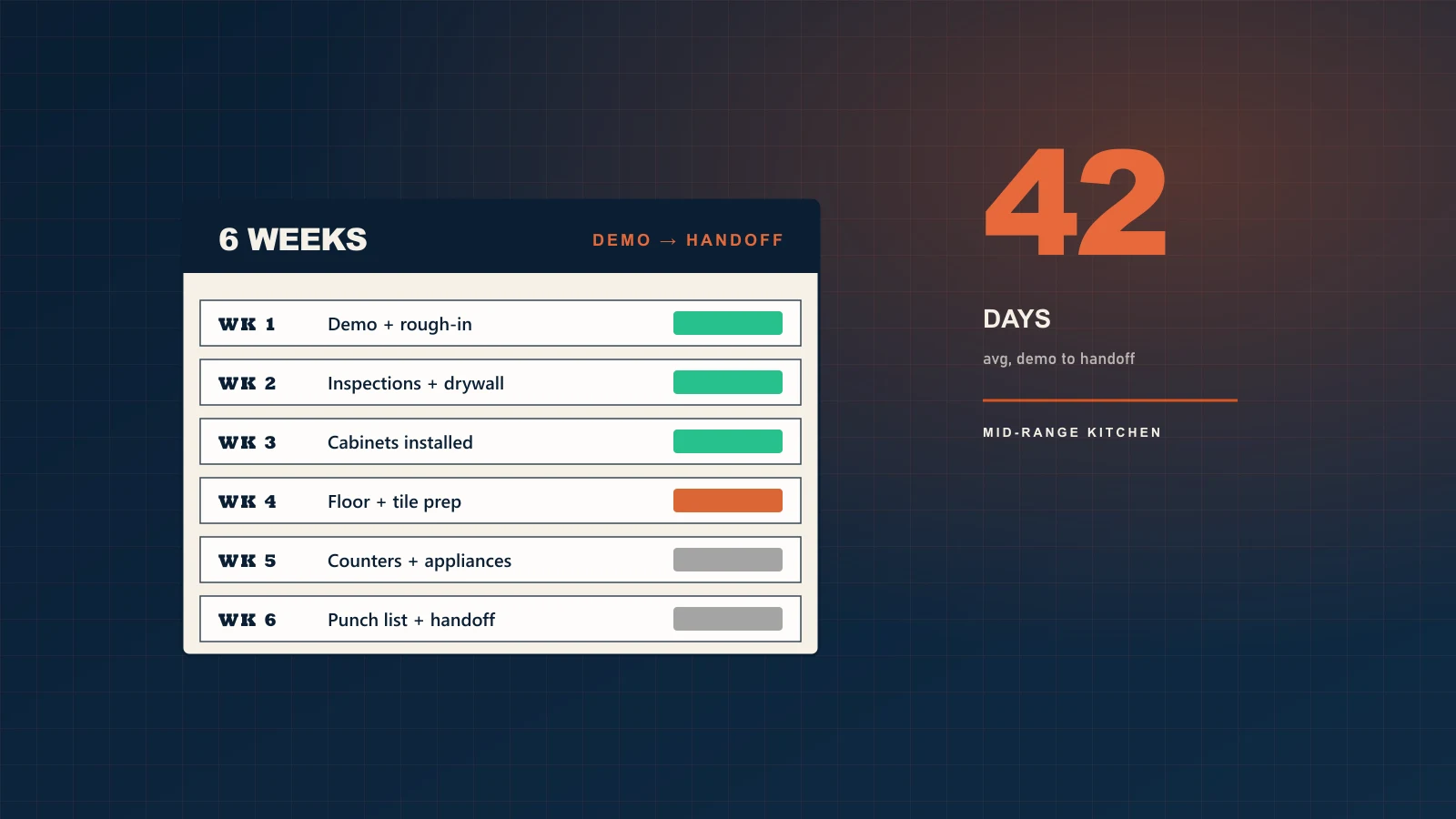
Below is the week-by-week breakdown of a 6-week project we'd do on an average 12'×14' kitchen with new cabinets. Quartz tops. Full backsplash, LVP floor, and updated electrical.
Pre-construction (4-8 weeks before demo)
Cabinets are the long pole. Order day one. While they're being built:
- Walk-throughs and final layout sign-off. Glenn visits twice, once to confirm dimensions, once to walk the layout with a tape measure on the floor.
- Material selections finalized. Counter slab picked at the fabricator. Tile pattern mocked up. Hardware ordered.
- Permits pulled. Electrical and plumbing permits in hand before week 1.
- Appliances delivered to your garage so they're not blocking the driveway during demo.
Week 1. Demo + rough-in start
Monday: dust walls go up at every doorway. Floor protection rolled to the front door. Existing cabinets, appliances, and tile come out, dumpstered same day.
Tuesday-Wednesday: any subfloor or wall surprises get documented (hello, knob-and-tube). Plumber and electrician arrive Tuesday afternoon to start rough-in.
Thursday-Friday: rough plumbing and electrical complete. Inspector scheduled for Monday of week 2.
Week 2. Inspections + drywall
Monday: inspections pass. (We schedule an early-week inspection so any failed item doesn't push the schedule.)
Tuesday-Friday: drywall hung, taped, mudded, sanded. Three coats of mud, dry between each. Skim coat where existing walls meet new.
Week 3. Cabinets in
Monday-Tuesday: cabinet boxes set, leveled, shimmed, screwed into studs. We do the upper run before the lower run so the shoe molding lands clean.
Wednesday: counter template guy comes out. He'll need the cabinets installed and level to template. His shop will fabricate over the next 7-10 days.
Thursday-Friday: under-cabinet lighting wired. Outlets and switches finished. Cabinet hardware installed.
Week 4. Floor + tile prep
Monday-Tuesday: LVP floor goes in. Acclimated for a week before this point, not optional.
Wednesday-Friday: backsplash tile prep. Surface flat, plumb. Tile spacing mocked up dry on the wall before any thinset gets mixed.
Week 5. Counter install + tile + appliances
Monday: counters arrive and install. Sink and faucet plumbed.
Tuesday-Thursday: backsplash tile, grout, caulk. Appliances slide into place. Range hood ducting confirmed venting to exterior (not to the cabinet above. We've fixed that mistake on prior contractor work too many times).
Friday: gas range or induction hookup, dishwasher hookup, fridge water line.
Week 6. Punch list + final clean
Monday-Wednesday: trim, paint, touch-ups. Glenn walks the punch list, anything he flags gets fixed before you see it.
Thursday: final clean (we use a real cleaning service, not a broom).
Friday: walk-through with you. Written workmanship warranty signed. Hold-back released.
What can stretch the timeline
- Cabinet delivery delays, most common cause of a slipped schedule. We order the day the contract is signed.
- Failed inspections. Rare with our crew, but a Friday-afternoon inspection failure pushes a week. Schedule inspections early in the week.
- Surprise rot, mold, or knob-and-tube in walls behind the demo. Documented same day, written change order before extra work starts.
- Material substitutions, your tile is back-ordered, you pick a different one, fabricator re-orders. Plan for 2-week buffer here.
What we'd quote you
A 6-week mid-range kitchen runs $32K-$42K all-in for a 12'×14' Taunton kitchen. Tell us about the project and Glenn will walk it within a week.
Why does cabinet lead time control the whole schedule?
Cabinets are the one material in a kitchen remodel that can't be rushed once ordered, because they're built to your specific dimensions and door style rather than pulled off a shelf. Everything else in the project, demo, rough-in, drywall, can be scheduled around the cabinet build window, but the cabinets themselves set the earliest possible start date for construction. That's why we order them the day the contract is signed rather than waiting until permits are pulled or demo is scheduled. A homeowner who delays the cabinet order to keep finalizing small decisions is often the reason a project's start date slips by weeks, not because of anything happening on site.
What actually happens during a plumbing or electrical inspection?
An inspector reviews the rough-in work, the pipes and wires that will be hidden behind drywall, before that work gets covered up and becomes impossible to verify without demolition. For electrical, that means checking wire gauge and circuit sizing against the load, proper grounding, and junction box placement. For plumbing, it means checking pipe sizing, proper venting, and that supply and drain lines are pitched and supported correctly. This is the reason inspections happen at a specific point in the schedule, after rough-in but before drywall, rather than at the end of the project. Catching a problem here costs a delay. Catching the same problem after drywall is hung costs a delay plus rework.
Why does the counter template happen after cabinets, not before?
Counters are templated (measured precisely for fabrication) only once the cabinets they'll sit on are installed and level, because even a small variance in cabinet height or position changes exactly where the counter's edges, cutouts, and seams need to fall. Templating before the cabinets are in would mean guessing at a dimension that hasn't been finalized yet, and quartz and granite slabs are cut once, not adjusted on site. This sequencing is also why counters take the better part of two weeks between template and install. The fabricator needs the precise measurements first, then real time to cut, polish edges, and prepare cutouts for the sink and cooktop before delivery.
What's the most common reason a kitchen project runs past its estimated timeline?
Beyond the cabinet and inspection risks already covered, the most common slip we see is a homeowner decision that comes later than planned, a tile pattern that gets changed after the original was ordered, a paint color chosen after the walls were already primed for something else. Every one of those changes is reasonable on its own, a kitchen is a big decision and it's normal to second-guess a choice partway through. The timeline impact comes from when the decision happens relative to the schedule, not from the decision itself. Finalizing selections before demo starts, even ones that feel minor, is the single biggest thing a homeowner can do to keep a 6-week project at 6 weeks.
Why does the timeline stretch so much for a full-gut project with structural changes?
Removing a wall, especially a load-bearing one, adds several sequential steps that a same-footprint remodel skips entirely: structural engineering review, permit approval specific to the structural change, installing a support beam, and then framing and drywall repair on both sides of where the wall used to be. Each of those steps has to happen in order and generally can't be compressed, since the engineering and permit approval need to be in hand before the wall actually comes down, and the beam has to be in before drywall can close the space back up. That sequencing, not the cabinet or finish selections, is the real reason a layout-change project runs 8 to 14 weeks instead of the 5 to 7 weeks of a same-footprint remodel.
What happens if a homeowner wants to live in the house during the remodel?
Most kitchen remodels are done with the homeowner living in the house throughout, and the main practical accommodation is a temporary kitchen setup, a folding table, a microwave, a mini-fridge, often in a dining room or basement, for the weeks the kitchen itself is unusable. Water access is typically maintained through a laundry room or bathroom sink during the rough-in and drywall weeks. The disruption is real but manageable for most households, and it's worth planning for explicitly at the start rather than improvising once demo begins, especially timing around any planned travel or hosting so the roughest weeks, demo and rough-in, don't collide with something important on your calendar.
Why does the punch list matter as much as the visible finish work?
A punch list is the final walkthrough where small, specific items get identified and fixed before a project is considered complete, a cabinet door that's slightly misaligned, a paint touch-up needed at a corner, a piece of trim that needs re-caulking. These are the details that don't show up in a quick glance but that you'll notice every day once you're living with the finished kitchen, which is why we walk it deliberately rather than treating the last coat of paint as the finish line. Items get fixed before you see the space as complete, not after, and the hold-back payment isn't released until that walkthrough is signed off, which keeps the incentive aligned on getting the small things right.
Does the timeline change for a kitchen with an island addition?
Adding an island where one didn't exist before typically adds electrical work (outlets are required in an island under current code) and sometimes plumbing if the island includes a prep sink, both of which extend the rough-in week somewhat compared to a kitchen keeping its existing footprint. It also adds a coordination point during the counter and cabinet weeks, since the island's cabinetry and counter need to align precisely with the surrounding layout and walkway clearances. It's a meaningful addition to plan for during the initial walk-through and layout sign-off rather than a late decision, since retrofitting an island's electrical and plumbing after cabinets are already set adds real time and cost that early planning avoids.
Why does the pre-construction phase matter as much as the build weeks themselves?
The 4 to 8 weeks before demo even starts, cabinet ordering, material selection, permitting, aren't downtime, they're what makes the 5 to 7 build weeks possible to run without pauses. A project that skips or rushes this phase, ordering cabinets late or finalizing tile after demo has already started, doesn't actually save time overall, it just moves the waiting into the middle of construction instead of before it, which is far more disruptive since the crew and your household are both already in the middle of the disruption. Treating the pre-construction weeks as seriously as the visible build weeks is one of the more underrated ways to keep a project on schedule.
What should you expect on the very last day of a kitchen remodel?
The final walk-through is a structured conversation, not a quick glance, where Glenn walks every surface and system with you, cabinet alignment, appliance operation, outlet function, paint touch-ups, and any items flagged go on the punch list to be corrected before the job is considered complete. This is also when the written workmanship warranty gets signed and the hold-back payment gets released, so it's worth treating this walk-through with the same attention you'd give the initial design meeting, rather than rushing through it because the kitchen already looks finished. Anything that bothers you at this stage is far easier to address now than after the crew has moved on to the next project.
Frequently asked questions
- Why does cabinet lead time control the whole schedule?
- Cabinets are the one material in a kitchen remodel that can't be rushed once ordered, because they're built to your specific dimensions and door style rather than pulled off a shelf. Everything else in the project, demo, rough-in, drywall, can be scheduled around the cabinet build window, but the cabinets themselves set the earliest possible start date for construction.
- What actually happens during a plumbing or electrical inspection?
- An inspector reviews the rough-in work, the pipes and wires that will be hidden behind drywall, before that work gets covered up and becomes impossible to verify without demolition. For electrical, that means checking wire gauge and circuit sizing against the load, proper grounding, and junction box placement.
- Why does the counter template happen after cabinets, not before?
- Counters are templated (measured precisely for fabrication) only once the cabinets they'll sit on are installed and level, because even a small variance in cabinet height or position changes exactly where the counter's edges, cutouts, and seams need to fall.
- What's the most common reason a kitchen project runs past its estimated timeline?
- Beyond the cabinet and inspection risks already covered, the most common slip we see is a homeowner decision that comes later than planned, a tile pattern that gets changed after the original was ordered, a paint color chosen after the walls were already primed for something else.
- Why does the timeline stretch so much for a full-gut project with structural changes?
- Removing a wall, especially a load-bearing one, adds several sequential steps that a same-footprint remodel skips entirely: structural engineering review, permit approval specific to the structural change, installing a support beam, and then framing and drywall repair on both sides of where the wall used to be.
- What happens if a homeowner wants to live in the house during the remodel?
- Most kitchen remodels are done with the homeowner living in the house throughout, and the main practical accommodation is a temporary kitchen setup, a folding table, a microwave, a mini-fridge, often in a dining room or basement, for the weeks the kitchen itself is unusable.
- kitchen remodeling
- timeline
- project planning
- Massachusetts